Back to Top

Tech, Web, Cloud & Cabling Services

Category: Tips & Info

Tips & Info Category

Microsoft’s latest Windows 10 ad annoys Chrome users with taskbar pop-ups

Ads on the Windows 10 taskbar aren’t just for Microsoft Edge anymore.

Microsoft’s aggressive advertising push inside Windows 10 is going beyond pop-ups for Microsoft Edge.

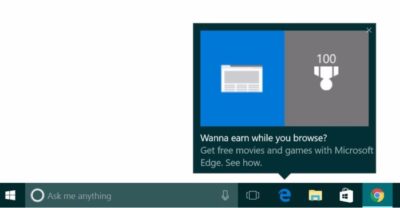
Myce recently spotted yet another pop-up ad on the taskbar in Windows 10. This time around Microsoft was advertising its extension for Chrome dubbed the Personal Shopping Assistant (Beta). The extension is a Microsoft Garage project that lets you compare prices across shopping sites.

Prior to the Chrome extension pop-up, Microsoft was advertising its rewards program for Microsoft Edge, which we spotted in early November. The earlier ad appeared to be targeted at people who didn’t use Edge that frequently.

A pop-up ad that promotes Windows 10’s Edge browser and Bing Rewards. The pop-up for the Chrome extension looks similar, as you can see on Myce.

The Chrome one, by comparison, is probably targeted at people who use Chrome as their default browser. Microsoft’s likely thinking that if people won’t stop using Chrome on Windows, at least they can use some Microsoft software while they’re doing it.

Microsoft told Thurrott.com that ads like the one for the Chrome extension are part of the company’s tests to provide, “new features and information that can help people enhance their Windows 10 experience.”

Tests or not, it’s unlikely that Microsoft will ever stop these taskbar ads even though users pay $100 or more for Windows. Thus far, Microsoft has advertised its own software and services.

The impact on you at home: If you want to make sure you don’t get pop-up ads on your taskbar you can turn them off. Open the Settings app and go to System > Notifications & Actions. On this screen under “Notifications” turn off Get tips, stricks, and suggestions as you use Windows. That’s not the only way Microsoft can advertise to you.

Have questions?

Get answers from Microsofts Cloud Solutions Partner!
Call us at: 856-745-9990 or visit: https://southjerseytechies.net/

South Jersey Techies, LL C is a full Managed Web and Technology Services Company providing IT Services, Website Design ServicesServer SupportNetwork ConsultingInternet PhonesCloud Solutions Provider and much more. Contact for More Information.

To read this article in its entirety click here.

Organize your intranet with SharePoint hub sites

New SharePoint hub sites make organizing and connecting your intranet easy. 

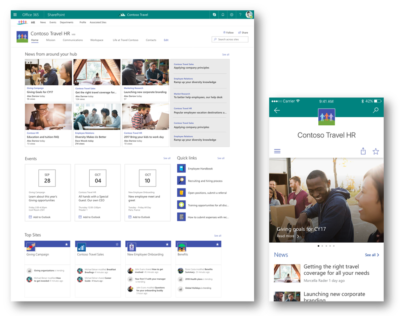
As business goals and team structures evolve, so too must your sites and the content that lives within them. Ideas must flourish and grow, not become rigid or stale. SharePoint hub sites bring flexible, dynamic building blocks to your company intranet – connecting collaboration and communication. Associating sites together in a hub site enhances discovery and engagement with content, while creating a complete and consistent representation of your project, department or region.

Microsoft first disclosed SharePoint hub sites during Ignite 2017. And recently they announced that they are now rolling out to Targeted Release customers in Office 365. Microsoft encouraged by early adopter feedback, can’t wait for every customer to use and adopt them.

SharePoint hub sites bring the following new capabilities to you and your intranet:

  • Cross-site navigation – increase visibility of and navigation among associated sites
  • Content rollup – read aggregated news and discover related site activities
  • Consistent look-and-feel – establish a common theme to improve visitor awareness of connected sites
  • Scoped search – focus on finding content that resides within the hub site’s associated sites

Hub sites support good governance, giving admins a growth framework to maintain relationships between sites over time. They are easy for admins to establish and bring efficiencies for people who work inside and across the sites on a day-to-day basis. And when managing change within the business, it is easy to move a site from one hub site to another.


Getting started with SharePoint hub sites in Office 365

You can convert an existing communication site or modern team time into a hub site, or you can start with a brand-new modern site. We recommend selecting a communication site as the hub site. You can associate multiple team sites and communication sites to model and promote an intranet that reflects the way your people organize. It is easy for admins to create one or more hub sites. After a hub site is created, approved site owners can associate existing team sites and communication sites with the hub site.


Use the SharePoint Online Management Shell to establish your hub sites

Admins, you are the enablers. And the SharePoint Online Management Shell (aka, PowerShell for SharePoint in Office 365) is your enabling tool of choice.

The PowerShell cmdlet you’ll want to get most familiar with is: Register-SPOHubSite https://contoso.sharepoint.com/sites/HR (where HR URL is the full-path address of the existing site that you want to convert into a hub site). You then will assign a unique security group to designate approved site owners that can associate sites to this new hub. You simply create a mail-enabled security group and add the users. You then run an additional PowerShell command to give that group permissions to associate their sites to the hub site.

Note: You must be a SharePoint administrator or above in Office 365 to create SharePoint hub sites. Site owners, however, can associate a SharePoint site with a hub site that already exists.

Learn more how admins create and manage hub sites.


Associating a site under a hub site

Once a hub site is established, it’s then a two-click process to associate to the hub site.

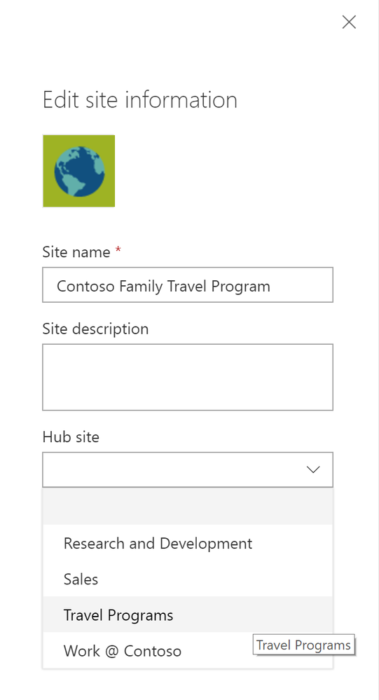
As the site owner, go to the site you want to have associated to the hub site. Click Settings (gear icon) > Site information > hub site association and select the desired hub.  You’ll only see the hubs you have permission to associate to. And then click Save. You will see the hub navigation appear above. The site itself will inherit the hub theme, and news and activities will begin to flow up to the hub site home page – along with a search crawl of content for any site associated to the hub site. And at any time, per a reorg or change in business direction, you can easily move sites between hub sites. This is the power of a dynamic intranet, one that can change and adapt with the ebb and flow of your ever-changing business landscape. Note: individual sites can only be associated to one hub site at a time.

Note: Sites associated with a SharePoint hub site don’t inherit the permissions of the hub site or any other sites associated with it. Each site, including the hub site, will retain their current permission settings. And as easy as it is to associate a site to a hub site, you, too, can dissaciate from one.

Learn more how to associate and dissociate your sites to and from hub sites.


Design your layout and choose you theme

Once the hub site has been established, you’ll then want to further set it up and refine it for that organization — so the hub site carries the right name and logo, the preferred navigation elements, a preferred theme, and the desired layout for news, sites and highlighted content. And all will re-flow and present beautifully within the SharePoint mobile apps.

The SharePoint mobile apps will display hub sites, and their pages, news, and content, with smooth navigation between associated sites and the scoped search experience. Find what you need on the go and get going! Install or update the SharePoint mobile app today: aka.ms/getSPmobile.

Surface Book pre-orders sold out at Microsoft’s online store

If you were still thinking about placing an order for a new Microsoft Surface Book, then you will have to look somewhere other than the Microsoft store.

surfacebook

While there doesn’t seem to be a massive supply issue with the new Apple iPhone 6s smartphone, in the past we have seen Apple products sell out quickly and deliveries move from days, to weeks, to months. It seems that Microsoft’s new Surface Book may be generating more interest than planned.

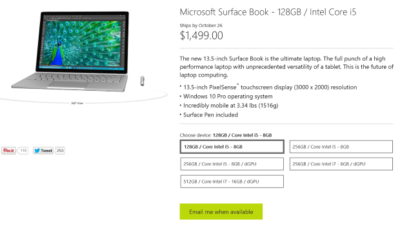
Last night I went to the online Microsoft Store to place an order for a base model Surface Book. I found that the only available status when choosing that model was, “Email me when available.” I jumped through the other four models and discovered the same thing. It seems Microsoft is sold out of pre-order stock for all models at its online store.

We reached out to Microsoft to try to find out more about stock status and when buyers could expect to place pre-orders. I also asked if there will be units in Microsoft retail stores on launch day, 26 October. Given that units are sold out online, we may even see people queue up for possible stock in stores.

A Microsoft spokesperson provided the following statement, “We’ve seen strong demand for Surface Book and have sold out of pre-order supply for October 26 availability. We will have limited quantities of Surface Book available in store on October 26 and will be updating online availability with new product ship dates soon.”

UPDATE: Microsoft updated its store and is no allowing customers to pre-order the five Surface Book variations. What you will find instead of an email me when available button is updated delivery expectations, ranging from five to six weeks for three models and seven to eight weeks for two models.

While I was disappointed that I couldn’t purchase a Surface Book through Microsoft directly, I found that Best Buy and Amazon will also be selling this new computer. Best Buy did not appear to be taking pre-orders, but I was able to purchase the Intel Core i5, 8GB, 128GB model from Amazon for $1,499.

The Amazon website does not appear to carry the 256GB i5 without dGPU or 256GB i7 models. The 256GB i5 with dGPU looks to be the only other model available for pre-order. The 512GB i7 model is on the site as an option, but redirects you to the Microsoft Store for purchase and it’s not avaialable there.

Have questions?

Get help from IT Experts/Microsofts Cloud Solutions Partner
Call us at: 856-745-9990 or visit: https://southjerseytechies.net/

South Jersey Techies, LLC is a full Managed Web and Technology Services Company providing IT Services, Website Design ServicesServer SupportNetwork ConsultingInternet PhonesCloud Solutions Provider and much more. Contact for More Information.

To read this article in its entirety click here.

Microsoft teases Windows 10’s sleek new look for the future

“Project Neon” will give your Windows 10 PC a fresh coat of paint later in 2017.

Microsoft’s planning a sleek visual refresh for Windows 10, and the company quietly teased its first official glimpse of what’s coming in the future during the Windows Developer Day keynote on Wednesday.

There aren’t many details being shared about “Project Neon” right now—as the refresh was called in earlier leaks—but the new visual look will focus on animations and transitions. The basic concept is “to add fluidity, animation, and blur to apps and the operating system,” as first reported by Windows Central. The new design language also hopes to make it easier for developers to create attractive apps.

The design refresh should extend to all Windows 10 devices including PCs and tablets, HoloLens, Xbox, and the few surviving Windows Phones, according to Windows Central.

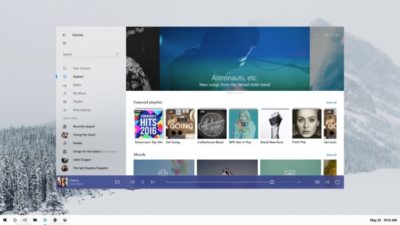
Twitter user Tom Hounsell shared a clean version of Microsoft’s first look at Windows 10’s forthcoming design tweaks. The image shown on the livestream had large text overlaid on top of the screenshot.

As you can see, this isn’t a huge change, but the visual refresh gives Windows 10 a sleeker, more modern feel. The taskbar icons look a little more dynamic and bolder. Cortana is using the icon instead of the search box, though it’s not clear if this will be the default look. The clock on the taskbar is also bolder, and the usual notification area icons including the Action Center are notably absent. The open Groove Music window itself looks more polished and Aero-esque as well, with no title bar to be seen—just unobtrusive options in the app’s upper-right corner.

The impact on you at home: Windows Central says that some of the code for Project Neon is already available in recent Insider Preview builds of Windows 10; however, it’s unlikely the visual refresh will be ready in time for the massive Creators Update this spring. Microsoft is expected to share more information about Neon during the Build conference in May. The Creators Update is expected to roll out in late March or early April, followed by a second major update later in 2017.

Have questions?

Get answers from Microsofts Cloud Solutions Partner!
Call us at: 856-745-9990 or visit: https://southjerseytechies.net/

South Jersey Techies, LL C is a full Managed Web and Technology Services Company providing IT Services, Website Design ServicesServer SupportNetwork ConsultingInternet PhonesCloud Solutions Provider and much more. Contact for More Information.

To read this article in its entirety click here.

Windows Tip of the week: Search for files and folders by date

Search for files and folders by date:

The more files you have, the more frustrating it can be to find the exact one you’re looking for. That’s especially true when you’re using search terms that are common to dozens or even hundreds of saved documents.

One great way to narrow the list is to enter a date-related search operator along with matching parameters, using the search box in the upper-right portion of File Explorer (Windows Explorer in Windows 7). For example, datemodified:2013 tax allows you to filter search results to show only files that contain the word tax and were last saved in 2013.

The search parameter you enter after the colon can be any date, even a partial one. So datemodified: June 2016 works even with the space included. To find only files before or after a given date, use the > and < operators, as in datemodified: >1/1/2016

If you prefer a point-and-click interface, just type datemodified: by itself and use the calendar or predefined options below it.

In Windows 8.1 and Windows 10, you’ll find date-related shortcuts on the Search tab, which appears on the File Explorer ribbon when you click in the search box.

Have questions?

For More Tips & Info from Microsofts Cloud Solutions Partner!
Call us at: 856-745-9990 or visit: https://southjerseytechies.net/

South Jersey Techies, LL C is a full Managed Web and Technology Services Company providing IT Services, Website Design ServicesServer SupportNetwork ConsultingInternet PhonesCloud Solutions Provider and much more. Contact for More Information.

Windows Tip of the week: Check your System Restore settings

Check your System Restore settings:

For many years, System Restore has been one of the most useful tools available for diagnosing and repairing Windows problems. Using System Restore (especially in Safe Mode), you can undo troublesome app installations or driver updates.

But System Restore only works if it’s turned on and properly configured. On Windows 10 devices, you might find that System Restore is disabled for the system (C:) drive.

Unless you’re convinced you’ll never need to use System Restore, I strongly recommend that you turn this feature on. From any supported Windows version, you can check the current configuration and change it if necessary by opening Control Panel > System And Security > System. Click Advanced System Settings in the sidebar on the left and then click the System Protection tab.

Select the C: drive from the Protection Settings list and click Configure. In Windows 8.1 and 10, this leads to a simple on-off switch. In Windows 7, you can choose whether to save previous versions of files as well as system settings. In either case, make sure you reserve enough space for the last restore point.

Have questions?

For More Tips & Info from Microsofts Cloud Solutions Partner!
Call us at: 856-745-9990 or visit: https://southjerseytechies.net/

South Jersey Techies, LL C is a full Managed Web and Technology Services Company providing IT Services, Website Design ServicesServer SupportNetwork ConsultingInternet PhonesCloud Solutions Provider and much more. Contact for More Information.

Windows Tip of the week: Add more places to send files

Add more places to send files:

When you are working in File Explorer and you right-click a file and navigate to the Send To menu item, you’ll see a small list of suggested places where you can send the file. If you Shift + right-click that file instead and then navigate to the Send To Menu item, you will be shown a much more extensive list of places where you can send that file.

Have questions?

For More Tips & Info from Microsofts Cloud Solutions Partner!
Call us at: 856-745-9990 or visit: https://southjerseytechies.net/

South Jersey Techies, LL C is a full Managed Web and Technology Services Company providing IT Services, Website Design ServicesServer SupportNetwork ConsultingInternet PhonesCloud Solutions Provider and much more. Contact for More Information.

Windows Tip of the week: How to Switch from Bing

Switch from Bing:
Microsoft would like you, and your personal assistant Cortana, to use Bing as your default search engine and not Google, etc. You can force Cortana to use a different search engine, but first you have to change your default web browser.

If Firefox is your default browser in Windows 10, Cortana should be using Google Search. If Chrome is your default browser, you have to install the Chrometana extension and change the default; otherwise, Cortana will be stubborn and keep using Bing.

Have questions?

For More Tips & Info from Microsofts Cloud Solutions Partner!
Call us at: 856-745-9990 or visit: https://southjerseytechies.net/

South Jersey Techies, LL C is a full Managed Web and Technology Services Company providing IT Services, Website Design ServicesServer SupportNetwork ConsultingInternet PhonesCloud Solutions Provider and much more. Contact for More Information.

Upgrade to Windows Server 2012

10 Compelling Reasons to Upgrade to Windows Server 2012

Takeaway: Windows Server 2012 is generating a significant buzz among IT pros. Deb Shinder highlights several notable enhancements and new capabilities.

We’ve had a chance to play around a bit with the release preview of Windows Server 2012. Some have been put off by the interface-formerly-known-as-Metro, but with more emphasis on Server Core and the Minimal Server Interface, the UI is unlikely to be a “make it or break it” issue for most of those who are deciding whether to upgrade. More important are the big changes and new capabilities that make Server 2012 better able to handle your network’s workloads and needs. That’s what has many IT pros excited.

Here are 10 reasons to give serious consideration to upgrading to Windows Server 2012 sooner rather than later.

1: Freedom of interface choice

A Server Core installation provides security and performance advantages, but in the past, you had to make a commitment: If you installed Server Core, you were stuck in the “dark place” with only the command line as your interface. Windows Server 2012 changes all that. Now we have choices.

The truth that Microsoft realized is that the command line is great for some tasks and the graphical interface is preferable for others. Server 2012 makes the graphic user interface a “feature” — one that can be turned on and off at will. You do it through the Remove Roles Or Features option in Server Manager.

2: Server Manager

Speaking of Server Manager (Figure A), even many of those who dislike the new tile-based interface overall have admitted that the design’s implementation in the new Server Manager is excellent.

One of the nicest things about the new Server Manager is the multi-server capabilities, which makes it easy to deploy roles and features remotely to physical and virtual servers. It’s easy to create a server group — a collection of servers that can be managed together. The remote administration improvements let you provision servers without having to make an RDP connection.

3: SMB 3.0

The Server Message Block (SMB) protocol has been significantly improved in Windows Server 2012 and Windows 8. The new version of SMB supports new file server features, such as SMB transparent failover , SMB Scale Out, SMB Multichannel, SMB Direct, SMB encryption, VSS for SMB file sharing, SMB directory leasing, and SMB PowerShell. That’s a lot of bang for the buck. It works beautifully with Hyper-V, so that VHD files and virtual machine configuration files can be hosted on SMB 3.0 shares. A SQL system database can be stored on an SMB share, as well, with improvements to performance. For more details about what’s new in SMB 3.0, see this blog post.

4: Dynamic Access Control (DAC)

Even though some say Microsoft has shifted the focus away from security in recent years, it would be more accurate to say it has shifted the focus from separate security products to a more “baked in” approach of integrating security into every part of the operating system.

Dynamic Access Control is one such example, helping IT pros create more centralized security models for access to network resources by tagging sensitive data both manually and automatically, based on factors such as the file content or the creator. Then claims based access controls can be applied. Read more about DAC in my “First Look” article over on Windowsecurity.com.

5: Storage Spaces

Storage is a hot — and complex — topic in the IT world these days. Despite the idea that we’re all going to be storing everything in the public cloud one day, that day is a long way off (and for many organizations concerned about security and reliability, it may never happen). There are myriad solutions for storing data on your network in a way that provides better utilization of storage resources, centralized management, and better scalability, along with security and reliability. Storage area networks (SANs) and network attached storage (NAS) do that, but they can be expensive and difficult to set up.

Storage Spaces is a new feature in Server 2012 that lets you use inexpensive hard drives to create a storage pool, which can then be divided into spaces that are used like physical disks. They can include hot standby drives and use redundancy methods such as 2- or 3-way mirroring or parity. You can add new disks any time, and a space can be larger than the physical capacity of the pool. When you add new drives, the space automatically uses the extra capacity. Read more about Storage Spaces in this MSDN blog post.

6: Hyper-V Replica

Virtualization is the name of the game in the server world these days, and Hyper-V is Microsoft’s answer to VMware. Although the latter had a big head start, Microsoft’s virtualization platform has been working hard at catching up, and many IT pros now believe it has surpassed its rival in many key areas. With each iteration, the Windows hypervisor gets a little better, and Hyper-V in Windows Server 2012 brings a number of new features to the table. One of the most interesting is Hyper-V Replica.

This is a replication mechanism that will be a disaster recovery godsend to SMBs that may not be able to deploy complex and costly replication solutions. It logs changes to the disks in a VM and uses compression to save on bandwidth, replicating from a primary server to a replica server. You can store multiple snapshots of a VM on the replica server and then select the one you want to use. It works with both standalone hosts and clusters in any combination (standalone to standalone, cluster to cluster, standalone to cluster or cluster to standalone). To find out more about Hyper-V replica, see this TechNet article.

7: Improvements to VDI

Windows Terminal Services has come a long way, baby, since I first met it in Windows NT TS Edition. Renamed Remote Desktop Services, it has expanded to encompass much more than the ability to RDP into the desktop of a remote machine. Microsoft offered a centralized Virtual Desktop Infrastructure (VDI) solution in Windows Server 2008 R2, but it was still a little rough around the edges. Significant improvements have been made in Server 2012.

You no longer need a dedicated GPU graphics card in the server to use RemoteFX, which vastly improves the quality of graphics over RDP. Instead, you can use a virtualized GPU on standard server hardware. USB over RDP is much better, and the Fair Share feature can manage how CPU, memory, disk space, and bandwidth are allocated among users to thwart bandwidth hogs. Read more about Server 2012 VDI and RDP improvements here.

8: DirectAccess without the hassle factor

DirectAccess was designed to be Microsoft’s “VPN replacement,” a way to create a secure connection from client to corporate network without the performance drain and with a more transparent user experience than a traditional VPN. Not only do users not have to deal with making the VPN work, but administrators get more control over the machines, with the ability to manage them even before users log in. You apply group policy using the same tools you use to manage computers physically located on the corporate network.

So why hasn’t everyone been using DirectAccess with Server 2008 R2 instead of VPNs? One big obstacle was the dependency on IPv6. Plus, it couldn’t be virtualized. Those obstacles are gone now. In Windows Server 2012, DirectAccess works with IPv4 without having to fool with conversion technologies, and the server running DirectAccess at the network edge can now be a Hyper-V virtual machine. The Server 2012 version of DA is also easier to configure, thanks to the new wizard.

9: ReFS

Despite the many advantages NTFS offers over early FAT file systems, it’s been around since 1993, and Windows aficionados have been longing for a new file system for quite some time. Way back in 2004, we were eagerly looking forward to WinFS, but Vista disappointed us by not including it. Likewise, there was speculation early on that a new file system would be introduced with Windows 7, but it didn’t happen.

Windows Server 2012 brings us our long-awaited new file system, ReFS or the Resilient File System. It supports many of the same features as NTFS, although it leaves behind some others, perhaps most notably file compression, EFS, and disk quotas. In return, ReFS gives us data verification and auto correction, and it’s designed to work with Storage Spaces to create shrinkable/expandable logical storage pools. The new file system is all about maximum scalability, supporting up to 16 exabytes in practice. (This is the theoretical maximum in the NTFS specifications, but in the real world, it’s limited to 16 terabytes.) ReFS supports a theoretical limit of 256 zetabytes (more than 270 billion terabytes). That allows for a lot of scaling.

10: Simplified Licensing

Anyone who has worked with server licenses might say the very term “simplified licensing” is an oxymoron. But Microsoft really has listened to customers who are confused and frustrated by the complexity involved in finding the right edition and figuring out what it’s really going to cost. Windows Server 2012 is offered in only four editions: Datacenter, Standard, Essentials, and Foundation. The first two are licensed per-processor plus CAL, and the latter two (for small businesses) are licensed per-server with limits on the number of user accounts (15 for Foundation and 25 for Essentials).

To View Full Article Click Here

10 tools that simplify collaboration

Takeaway: The key to collaborating effectively is to find tools that make working with others easy and efficient. Jack Wallen shares a list of tools that have greatly improved the collaborative process for his projects.

You might notice that not all tools listed were actually designed specifically for the task of collaboration. Some are communication tools, whereas others serve a much broader purpose. No matter their original purpose, each one makes collaboration much easier. In the end, all that matters is that you can work with your collaborators without having to leave town, host a face-to-face meeting, or run up your phone bill.

1: Google Docs
That’s right. The mighty Google has finally added a level of collaboration to its documents. Google documents now have a discussion feature, which allows the creator of a document to invite participants to collaborate (discuss) on it. What’s nice about this feature is that it is in real time and can be saved for later reference. Google docs are gaining ground, people!

2: Track Changes
In both Microsoft Office and LibreOffice, anyone who is collaborating on a document can take advantage of track changes. If you’re collaborating on a document in either of these office suites and you aren’t using track changes, you have no idea what you are missing. The ability to show what has been changed (and by whom), as well as to easily accept or reject those changes, goes a long way toward streamlining the collaboration process. The only downfall to track changes is that it is not in real time. But not many tools allow you to collaborate in real time on documents.

3: Comments
Another collaboration feature in both Microsoft Office and LibreOffice is the ability to insert comments into text. This is often used in conjunction with track changes to explain a change or ask a question. Anyone who plans on collaborating must have this feature in their toolbox. If you don’t use comments, you wind up sticking notes inline — which often ends badly when the comments are not removed before publication.

4: Gobby/Kobby
Gobby and Kobby offer the same function — real-time collaboration on text documents in Linux. These tools serve as a sort of chat client with a built-in text editor. The primary audience for both Gobby and Kobby is the developer, but that doesn’t mean they can’t be used for ordinary document collaboration. The downfall? Neither one supports the most popular word processor formats (such as .doc, .rtf, .and odt).

5: Instant messaging
I know, I know. IM isn’t technically a collaboration tool. But if you really think about it, how is it not? You can fire up your document, log on to your instant messaging client, and start chatting with your collaborators in real time about the work. No, you do not see changes as they are made, and any updates to the document are not made for all to see. But the truth of the matter is, the primary function of collaboration is communication, and using an instant messaging tool is a fantastic way to communicate.

6: Zoho
Zoho is an incredible Web-based collaboration tool. With Zoho, you can collaborate via chats, discussions, email, meetings, projects, wikis, and more. There are so many ways that Zoho helps you to collaborate, it would be serious feat to actually use them all for a single project. Although Zoho has a free plan for its service, you get only 1 GB of space for files. But its premium service is only $5 per month, so if you are a frequent collaborator and you’re looking for a great Web-based tool to facilitate collaboration, Zoho might be the perfect fit.

7: Campfire
Campfire is another Web-based collaboration tool, but it’s aimed at the corporate or enterprise-level crowds. With plans that reach all the way to 100 chatters and 25 GB of storage (a plan that costs $99 per month), Campfire can enable collaboration in larger settings or even classrooms. Campfire also packs in other enterprise-friendly features, such as searchability and an iPhone app for mobile collaboration. An extra benefit of the pricier plans is that they incorporated SSL for higher security.

8: MindMeister
MindMeister is a Web-based mind-mapping tool. Not all collaborators are familiar with (or comfortable with) mind-mapping tools. But for those who are, there is no better way to brainstorm an idea than a mind-mapping tool. Having a tool for mind-mapping available online is a brilliant way to get those ideas out of your head and into reality. MindMeister has three plans: Free (three maps), Premium — $59 per year (unlimited maps, enhanced security, upload files), and Business — $9 per month (unlimited maps, edit maps offline, branded subdomain, auto backups). MindMeister also has an app for iPhone and iPad.

9: TextFlow
TextFlow is an online document comparison tool. It allows you to generate change reports from Word and PDF documents. You can compare up to seven documents at once, see the changes in context, view the changes in a summary report, and even view the change history. Although the layout of the changes can take a bit of acclimation, the benefits of using such a tool far outweigh the somewhat awkward layout.

10: Kablink
Kablink is a set of open source, online collaboration tools. The set consists of Teaming, iFolder, and Conferencing. Teaming includes document management, workflow, expertise location, federated search, and a custom Web form generator. ifolder is a secure storage solution similar to that of Dropbox, but it also allows you to invite other iFolder users to share your folders. Conferencing is a real-time meeting solution that allows application sharing, whiteboards, presentations, and more. All three of the Kablink tools are cross platform.

Other tools?
If you try out the tools on this list, you should be able to find a collaboration solution that meets your needs. Although you may have to use a combination of tools, you should be able to find everything you need to get your collaboration up and running with very little effort.

Have you worked successfully with some of these tools? What other solutions would you add to the list?

To view the original article in it’s entirety Click Here

CALL US NOW!