Back to Top

Tech, Web, Cloud & Cabling Services

10 Great Tools For A Budget

Takeaway: From diagnostic tools to antivirus to backup utilities, this list of freebies will help you do more with less.

If you’re trying to stretch a thin IT budget, you probably can’t afford a lot of pricey tools. Luckily, a number of highly useful tools are available for free. Some of them even work better and are more efficient than their costlier alternatives.

1: ComboFix

When the standard antivirus/malware software can’t seem to find the problem, ComboFix almost always does. It also looks for and removes most rootkits and Trojans. To use this tool, you must completely disable all antivirus solutions (and you should completely remove AVG). Caution: If ComboFix is not used properly, it can wreak havoc on the machine you’re trying to fix.

2: ProduKey

ProduKey will help you get product keys from installed applications so that when you need to migrate to a new machine, you can continue using those costly licenses. ProduKey will recover keys from more than 1,000 software titles, including Microsoft Office, Adobe, and Symantec. When you use this tool, you will have both the product ID and the product key; the ID is important because it will tell you which version of the software is installed.

3: Hiren’s BootCD

Hiren’s BootCD is a one-stop-shop Linux boot disk that can help you pull off a number of small miracles. Its tools include Antivir, ClamWin, ComboFix, Clonedisk, Image for Windows, BIOS Cracker, 7-Zip, Bulk Rename, Mini Windows XP, CCleaner, and Notepad++, among others. This single bootable disk could easily be the only tool you need.

4: Microsoft Security Essentials

Microsoft Security Essentials is one of the better free antivirus tools available. Its tagline, “The anti-annoying, anti-expensive, anti-virus program,” is true. When the firm I work with was looking for a new free solution, we tested Microsoft Security Essentials against AVG Free and Avast Free and found Microsoft Security Essentials to be superior, less intrusive, and less resource intensive.

Note: Microsoft Security Essentials can be used for free for up to 10 PCs. Beyond that, you can purchase the business version, System Center Endpoint Protection.

5: WinDirStat

WinDirStat is the program you need when you must know what is taking up the space on a hard drive. When C drives begin to fill up, performance degrades rapidly. It’s essential to have a tool to help you discern what is gobbling up the precious space on a machine, and WinDirStat is the foremost app for getting this information quickly.

6: CCleaner

CCleaner gets rid of temporary files and Windows Registry problems faster than any other tool. When a machine is having problems, this is almost always the tool I use first. CCleaner also helps ensure privacy by getting rid of traces left behind (such as cookies) by Web browsers.

Note: It is legal to use CCleaner Free for business use. However, CCleaner Business Editioncomes with a few more features (including one-click cleaning) than the free version.

7: Defraggler

Defraggler blows away the defragmenting application in all Windows operating systems. It’s faster, more reliable, and more flexible than the built-in tools. With Defraggler, you can defrag a single file or an entire drive. Defraggler supports NTFS and FAT32 systems.

8: 7-Zip

7-Zip is the best file archiver/compression tool (outside of Linux command-line tools). It’s open source and works on multiple platforms. Once you install it, you will find 7-Zip has Explorer support and a simple GUI tool that any level of user can manage.

9: SyncBack

SyncBack is a reliable, easy-to-use backup utility. No, you won’t be recovering from bare metal, but you can save your precious data. SyncBack can synchronize data to the same drive, a different drive or medium (CDRW, CompactFlash, etc.), an FTP server, a network, or a zip archive.

10: FileZilla

FileZilla reminds you that the cloud has not made FTP useless. There are plenty of reasons you might need FTP, so why not use one of the best and most cost effective FTP clients? And if you need an easy-to-use FTP server to slap up on your Windows machines, FileZilla has one.

Can’t Change Windows 7 Theme?

Can’t change the Windows 7 theme? Is your Windows 7 theme stuck on “classic”? If it is stuck, then you can try to apply a few fixes and see if if you can unstuck it! Often it is stuck, because your PC is configured to be optimized for best performance, rather than best appearance!


Windows

Overview

Configure PC for better Appearance
Start Windows 7 Themes Service
Problem: Themes Service Cannot Be Started

Use Visual Styles on Windows and Buttons

Often the reason why your Windows 7 theme could be stuck on classic is that your PC is configured to be optimized for better performance. I could imagine that some laptops are even pre-configured that way. Actually, it’s a good setting, but if you want a better appearance I can understand that it’s annoying to be stuck on “classic” theme. So, if you can’t change your Windows 7 theme, you might want to check your PC configuration first:

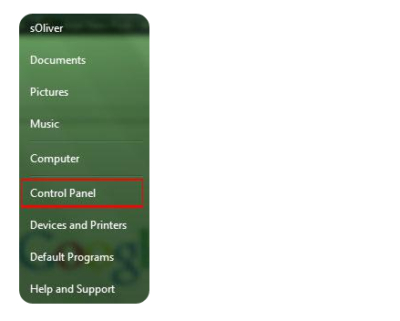
1. StepOpen the Control Panel

Control Panel


2.
Click on “System and Security”:

3. Step Click on “System”.

4. Step In the sidebar, click on “Advanced System Settings”:

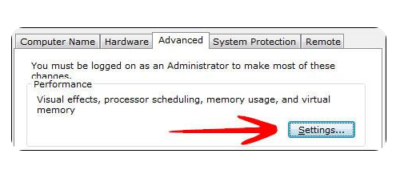
5. Go to the tab “Advanced” and click on “Settings”:

System and Security


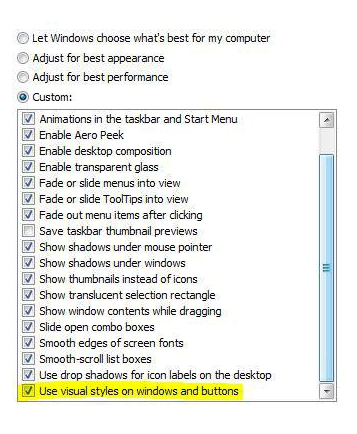
6. Step Scroll down the list, at the bottom double-check that the item “Use Visual Styles on Windows and Buttons” is checked. If this is not checked, your Windows 7 theme will be stuck on “classic” for a long time, because this completely disables your fancy visual Aero appearance.

Windows 7 Themes

This is also often the problem why people can’t seem to be able to active the Windows 7 Aero theme, because their PC is configured to be optimized for the best performance and not the best appearance.

Themes service is not started

If your Windows 7 themes service is not started your Windows 7 theme will be stuck on “classic”. You can’t change your Windows 7 theme when the theme service is disabled. So, let’s check if your themes service is up and running.

1. Step Click on “Start” and enter “services.msc” into the search field. Click on the item that appears.

2. Step Scroll down the list until you find the item “Themes” (or enter Themes while one item is selected)

3. StepYou will now see if the Themes service is running currently and what mode it is in (Automatic, Disabled, Manual):

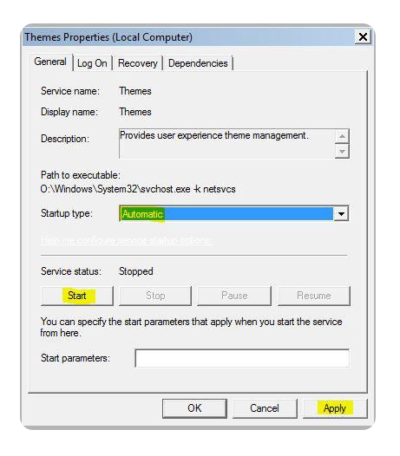
If it’s currently “Disabled” or in “Manual” mode and not started, you have to start it manually and change the mode to “Automatic”.

4. StepDouble-click on “Themes” and from the dropdown select “Automatic”, click on “Start” and then on “Apply”.

Themes Properties

Have questions?

Microsoft’s Cloud Solutions Partner are here to help.
Call us at: 856-745-9990 or visit: http://southjerseytechies.net/

South Jersey Techies, LLC is a full Managed Web and Technology Services Company providing IT Services, Website Design ServicesServer SupportNetwork ConsultingInternet PhonesCloud Solutions Provider and much more. Contact for More Information.

To read this article in its entirety click here.


Verizon officially lands iPhone

Takeaway: It’s official. Verizon is getting the iPhone. There are five big questions that we’ve been hearing in relation to the iPhone 4 launch on Verizon. Here are the answers.

It’s official. AT&T’s deal as the exclusive US carrier for the iPhone has ended (apparently the 4-year deal concluded at the end of 2010), and Verizon is the first new US telecom to add the iPhone to its roster. The long-anticipated move was announced at a Verizon press event at New York’s Lincoln Center on Tuesday in the midst of a circus atmosphere that included the tech press, all of the national news networks, and even The Daily Show.

The iPhone 4 will arrive on Verizon on February 10. Current Verizon customers will be able to pre-order online starting February 3. The price of the iPhone will remain the same: $199 for 16GB and $299 for 32GB, with a two-year Verizon contract. As for the price of Verizon data plans for the iPhone, Verizon coyly stated, “Customers will also be required to activate a data package. Pricing will be announced at a later date.”

It’s odd that the iPhone wouldn’t simply use the existing Verizon 3G data plans. This seems to indicate a couple possible scenarios. Either: 1.) Verizon is going to have a special data plan just for the iPhone (it has been rumored that Verizon would offer a truly unlimited data plan for iPhone), or 2.) Verizon is about to change the price of all of its 3G data plans in conjunction with the iPhone launch.

Beyond the basic details, here are answers to five big questions that we’ve been hearing from our audience in relation to the iPhone finally landing on Verizon:

1. Will it be CDMA or LTE?
Unfortunately, the iPhone 4 will only run on Verizon’s 3G CDMA network and not on its newly-launched 4G LTE network. This was the biggest disappointment of the Verizon iPhone announcement, especially since upcoming Android devices like the HTC Thunderbolt and Motorola Droid Bionic will be running on the LTE superhighway in a few months. At CES last week I tested the HTC Thunderbolt on the Verizon LTE network and was blown away by the desktop-like speeds for loading Web pages. At today’s press event Apple said that including LTE in the iPhone 4 would have involved “design compromises” (probably in size and battery life) and would have taken longer before it was ready to launch. However, both Apple and Verizon stated that this is just the beginning of their partnership (Translation: Expect an LTE-capable iPhone in the future).

2. Will it have mobile hotspot capability?
The biggest surprise of the Verizon iPhone announcement — and arguably the biggest news of the press conference since everything else was pretty much as expected — was that the Verizon version of the iPhone will offer the capability of turning itself into a mobile hotspot that can share its 3G Internet connection over Wi-Fi with up to five devices. Again, no information was provided on whether Verizon will charge extra for mobile hotspot capability. Verizon has wide variations in its treatment of tethering and mobile hotspot charges. It has charged Android users an additional fee for it, but threw it in for free to Palm Pre Plus users. What they do with the iPhone will probably depend on how aggressively the company wants to try to poach current AT&T iPhone customers.

3. Does new Verizon model fix iPhone 4’s antenna?
As you’ve probably heard, when the iPhone 4 first launched last June there were a bunch of customers who experienced antenna problems when holding the iPhone in a way that covered a sensitive portion of the antenna in the lower left-hand corner of the phone. The problem was drastically overblown by the tech press and drastically understated by Apple. In the end, Apple said the problem was significantly reduced if you use an iPhone case and offered free cases to buyers. A number of people have asked if Apple has fixed the problem in this new iteration of the iPhone 4 for Verizon. Naturally, Apple hasn’t said that it has changed anything with the iPhone antenna, but a closer look at the Verizon iPhone shows that it does indeed have a different antenna design and early reports indicate that the Verizon iPhone is not exhibiting the antenna problems.

4. Can you transfer an existing iPhone to Verizon?
The AT&T version of both the iPhone 3GS (which just got a price drop to $50) and iPhone 4 are built on what’s called GSM radio technology (used by both AT&T and T-Mobile in the US). Meanwhile, Verizon and Sprint use a completely different technology called CDMA. The two standards are incompatible. They use different radios and operate on different wireless frequencies. So, no, you cannot take your existing AT&T iPhone and walk into a Verizon store and simply switch networks. Even if you own an iPhone 4 you will have to purchase a completely new iPhone 4 with CDMA chips in order for it to work on Verizon.

5. Will iPhone kill Verizon’s network like it did to AT&T?
Another question that we heard a lot leading up to the expected announcement of the Verizon iPhone today was whether the influx of millions of new iPhone users would bring the Verizon network to its knees the same way it has crushed the AT&T network in areas such as New York, San Francisco, and Los Angeles and at big events like CES and SXSW. I think the answer is “no,” for several reasons. First of all, Verizon is a lot more serious than any of the other US wireless carriers when it comes to network integrity. They aggressively test and audit their own network, so I’ll think they’ll be ready. Second, they just beefed up all of their cell sites to handle additional bandwidth and network load for the launch of their 4G LTE network in 38 cities and they are in the process of upgrading the rest of the US to LTE over the next 24-36 months. Third, while there will be plenty of existing Verizon customers who jump on board with the iPhone and some die-hards who jump from AT&T to Verizon, the vast majority of iPhone customers will remain on AT&T because they are under contract and leaving would be prohibitively expensive.

To view the original article in it’s entirety, Click Here

Warm Laptop on Legs Can Harm Skin

CHICAGO — Have you ever worked on your laptop computer with it sitting on your lap, heating up your legs? If so, you might want to rethink that habit.

Doing it a lot can lead to “toasted skin syndrome,” an unusual-looking mottled skin condition caused by long-term heat exposure, according to medical reports.

In one recent case, a 12-year-old boy developed a sponge-patterned skin discoloration on his left thigh after playing computer games a few hours every day for several months.

“He recognized that the laptop got hot on the left side; however, regardless of that, he did not change its position,” Swiss researchers reported in an article published Monday in the journal Pediatrics.

Another case involved a Virginia law student who sought treatment for the mottled discoloration on her leg.

Dr. Kimberley Salkey, who treated the young woman, was stumped until she learned the student spent about six hours a day working with her computer propped on her lap. The temperature underneath registered 125 degrees.

That case, from 2007, is one of 10 laptop-related cases reported in medical journals in the past six years.

The condition also can be caused by overuse of heating pads and other heat sources that usually aren’t hot enough to cause burns. It’s generally harmless but can cause permanent skin darkening. In very rare cases, it can cause damage leading to skin cancers, said the Swiss researchers, Drs. Andreas Arnold and Peter Itin from University Hospital Basel. They do not cite any skin cancer cases linked to laptop use, but suggest, to be safe, placing a carrying case or other heat shield under the laptop if you have to hold it in your lap.

Salkey, an assistant dermatology professor at Eastern Virginia Medical School, said that under the microscope, the affected skin resembles skin damaged by long-term sun exposure.

Major manufacturers including Apple, Hewlett Packard and Dell warn in user manuals against placing laptops on laps or exposed skin for extended periods of time because of the risk for burns.

View full sizeAP Photo/HO via PediatricsA 12-year-old boy with evidence of “toasted skin syndrome” on his left leg caused by exposure to high temperatures while spending a great deal of time playing video games with a laptop resting on his legs.

A medical report several years ago found that men who used laptops on their laps had elevated scrotum temperatures. If prolonged, that kind of heat can decrease sperm production, which can potentially lead to infertility. Whether laptop use itself can cause that kind of harm hasn’t been confirmed.

In the past, “toasted skin syndrome” has occurred in workers whose jobs require being close to a heat source, including bakers and glass blowers, and, before central heating, in people who huddled near potbellied stoves to stay warm.

Dr. Anthony J. Mancini, dermatology chief at Children’s Memorial Hospital in Chicago, said he’d treated a boy who developed the condition from using a heating pad “hours at a time” to soothe a thigh injured in soccer. Mancini said he’d also seen a case caused by a hot water bottle.

He noted that chronic, prolonged skin inflammation can potentially increase chances for squamous cell skin cancer, which is more aggressive than the most common skin cancer. But Mancini said it’s unlikely computer use would lead to cancer since it’s so easy to avoid prolonged close skin contact with laptops.

To view the full article Click Here

Why You Should Upgrade to Office 2010

The latest version of Microsoft Office offers a multitude of collaboration tools to streamline the way you communicate with you coworkers and clients.

1- Express your ideas more visually.
Office 2010 opens up a world of design options to help you express your ideas with more impact. New and improved picture formatting tools, such as color saturation and artistic effects, let you transform your visuals into works of art. And a wide range of new customizable themes and SmartArt® graphic layouts offer more ways to make your ideas stick.

2 – Accomplish more when working together.
Brainstorm ideas, keep versions in sync, and meet deadlines faster when you’re working in groups. Co-authoring in Word 2010, PowerPoint 2010, Excel Web App, and OneNote 2010 shared notebooks enable you to edit the same file at the same time with other people — even when they’re in different locations.1

3 – Enjoy the familiar Office experience from more locations and devices.
With Office 2010, you can get things done on your schedule.
• Microsoft Office Web Apps. Extend your Office 2010 experience to the Web. Store your Word, Excel, PowerPoint, and OneNote files online and then access, view, edit, and share content from virtually anywhere.2
• Microsoft Office Mobile 2010. Stay current and respond quickly using new mobile versions of Office 2010 applications designed specifically for your Windows phone.3
• Microsoft SharePoint Workspace 2010. Synchronize SharePoint 2010 lists and libraries with SharePoint Workspace, formerly known as Microsoft Office Groove, so you can access, view, and edit files anytime and anywhere from your computer. Everything will automatically sync to the SharePoint server when you’re back online.

4 – Stay connected to your business and social networks.
Outlook 2010 is your hub for colleagues, customers, and friends. Use Outlook Social Connector to quickly view history of e-mails, meetings, or attachments you receive from individuals. Get additional information about people to stay on top of your business and social circles through SharePoint My Site, Windows Live, or other popular third-party sites.

5 – Get your message out instantly.
Broadcast your PowerPoint presentation to a remote audience, whether or not they have PowerPoint installed.4 The new PowerPoint Broadcast Slide Show feature enables you to present right from your desk, while your audience views the presentation live in their Web browser.

6 – Create powerful data insights.
Track and highlight important trends with new data analysis and visualization features in Excel 2010. The new Sparklines feature delivers a clear and compact visual representation of your data through small charts within worksheet cells. Slicers let you filter and segment your PivotTable data in multiple layers so you can spend more time analyzing and less time formatting.

7 – Manage large volumes of e-mail with ease.
Save valuable time by streamlining your inbox. Outlook 2010 lets you compress long e-mail threads into a few conversations that can be categorized, prioritized, and conveniently filed. The new Quick Steps feature lets you perform multi-command tasks, such as reply and delete, with a single click.

8 – Deliver compelling presentations.
Captivate your audience with personalized videos in your presentations. Embed and edit videos directly in PowerPoint 2010. Trim, add fades and effects, or bookmark key scenes. Videos inserted from your files are now embedded by default, so you can share your dynamic presentations without having to manage separate media files.

9 – Store and track all of your ideas in one place.
Get the ultimate digital notebook for tracking, organizing, and sharing text, pictures, and audio and video files with OneNote 2010. New features such as page version tracking, automatic highlighting, and Linked Notes give you more control over your information, so you’re always on top of your content and changes made by others.

10 – Work your way, faster and more easily.
Microsoft Office Backstage™ view replaces the traditional File menu to give you a centralized space for all of your file management tasks, including save, share, print, and publish. The enhanced Ribbon, common across Office 2010 applications, lets you access commands quickly and create or customize tabs to fit your work style.


Windows 10 Privacy Settings Guide

Where do you draw the line on personal privacy? The right options are different for everyone. This guide shows the privacy settings that will help you to create the right balance of privacy and convenience in Windows 10.

Over the past year, We’ve read countless “privacy guides” for Windows 10. Most are well-intentioned, but they invariably take a simplistic approach to privacy: Just turn off every switch in the Privacy section of the Settings app.

If you do that, you’re not understanding the privacy landscape, which encompasses far more than just those settings. You’re also missing some important additional steps.

Windows 10 is a mix of software and services. With every session, a Windows 10 device exchanges a great deal of information with Microsoft’s servers. That’s neither unusual nor alarming. Microsoft’s chief rivals, Google and Apple, are also blending services into their software, with the goal of making your life easier and making that software more reliable.

So are other tech companies that you don’t think of as software companies: Amazon, with the Echo. Tesla, with its self-updating, software-driven cars. Your thermostat and your home security system.

There’s something profoundly satisfying about a service that anticipates your every move, reminding you when to leave for an appointment to arrive on time, or to pick up flowers for your anniversary tomorrow. Your digital personal assistant, whether it’s Siri or Cortana or Alexa or Google, needs to be able to see your calendar and contacts to make that magic happen.

But when that sort of personal attention goes too far, it “crosses the creepy line,” to use a phrase that Eric Schmidt probably regrets uttering when he was Google’s CEO.

The thing about that line is that it’s drawn in a different place for everyone. There are people who are thrilled at the idea that their PC or mobile device is so familiar with their actions that it can anticipate what they’ll do next. I know others who would like to build a virtual Faraday cage around their computing hardware so that none of their personal details can escape.

Both of those viewpoints, and everything in between, are perfectly valid. That’s why the software and services we use are loaded with switches and dials designed to help you take control of their potential privacy impact.

In this post, We’ll walk you through the big privacy questions for Windows 10, with enough context to help you decide which settings are right for you.

Note that this guide assumes you are using Windows 10 on a personal PC or one in your small business. If you are in an enterprise setting, or if you are in a regulated industry, you should seek professional assistance to ensure that you’re meeting proper standards.

Let’s start with the part of your PC that has the biggest impact on your personal privacy.

THE NETWORK

No one knows more about your online identity than your Internet service provider. Every packet you send or receive from anywhere online goes through their servers. When you travel and connect to Wi-Fi networks that are under the control of others, the owners of those networks can see every connection you make and can intercept their contents.

Regardless of the platform you use, that’s why it’s important you use encrypted connections for any kind of sensitive communications. Using a virtual private network whenever possible is an excellent best practice.

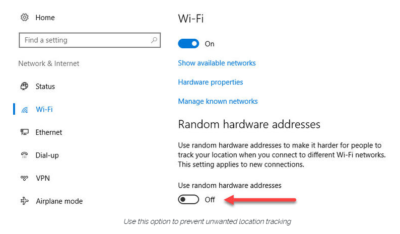
Windows 10 does offer one obscure option that can help protect third parties from tracking your movements based on your connections to Wi-Fi networks. (Note that this feature requires support from your Wi-Fi adapter, so if you don’t see this option, the most likely explanation is that your hardware doesn’t support it.) Under Settings > Network & Internet > Wi-Fi, turn the Use random hardware addresses setting to On.
windowsprivacy02

That step keeps third parties from matching your Wi-Fi adapter’s hardware address with your personal information, making it more difficult to track your location.

THE BROWSER

Countless third-party ad networks and analytics companies use cookies and other tracking technology to record your movements around the web and to correlate your online activities with your offline identity.

The result is a digital fingerprint that can be extraordinarily detailed and, unfortunately, outside of your ability to change.

To limit the amount of information that those ad and analytics companies know about you from your web browsing, consider third-party anti-tracking software such as Abine’s Blur, which is available for every web browser except Microsoft Edge. (That lack of solid support for add-ons is one reason I can’t yet recommend Edge as a full-time browser for most Windows 10 users.)

Another privacy product worth considering is Ghostery, although some are suspicious of this browser extension because of its uncomfortably close ties to the online advertising industry.

Ad-blocking software can also provide some privacy protection as a side-effect of performing its basic function. Here, too, watch out for close ties between some ad-blocking add-ins and the third-party trackers they supposedly protect you from.

Note that none of these steps is unique to Windows 10. Anti-tracking software is typically a browser add-in and works with most popular browsers.

THE OPERATING SYSTEM

With those two big, platform-independent factors out of the way, we can now turn to Windows 10 itself. When you use a Windows 10 device, it is capable of sharing the following types of information with Microsoft’s servers:

Your location

Windows 10 can determine your location to help with actions like automatically setting your current time zone. It can also record a location history on a per-device basis. Go to Settings > Privacy > Location to control the following:

  • Location on/off?Use the master switch at the top of this page to disable all location features for all users of the current device.
  • Location service on/off?If location is on for Windows, you can still turn it off for your user account here.
  • General location?This allows you to set a city, zip code, or region so that apps can deliver relevant content.
  • Default location?Click Set default to open the Maps app and specify the location you want Windows to use when a more precise location is not available.
  • Location history?Click Clear to erase the saved history for a Windows 10 device.

If location is on, a list at the bottom of the Settings > Privacy > Location page allows you to disable access to that data on a per-app basis.

Your input

If you enable Cortana, Windows 10 uploads some info from your devices, such as your calendar, contacts, and location and browsing history, so that Cortana can make personalized recommendations. If you don’t want any accounts on your PC to use Cortana, follow the steps in this article to disable the feature completely: Turn off Cortana completely.

Windows 10 uses some feedback from the way you type, write, and speak to improve performance for you and as a way to improve the overall platform. This isn’t keystroke logging; rather, the operating system uses a very small amount of information. A separate feature uses your speech and writing history to make better suggestions in Windows and Cortana.

You can control this collection with two sets of controls:

Under Settings > Privacy > General, click Info about how I write and turn it off so that your typos aren’t used to improve things like the built-in spell checker.

Under Settings > Privacy > Speech, inking, & typing, under the Getting to know you heading, click Stop getting to know me to turn off personalization.

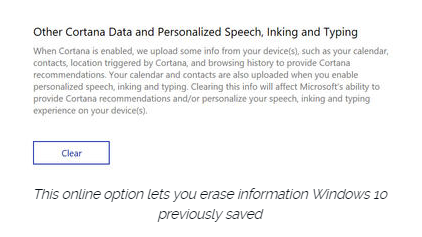
To clear previously saved information associated with your Microsoft account, click the first link under the Manage cloud info heading. That takes you to this Bing Personalization page, which includes this prominent button:
windows-privacy01

Click Clear to remove that saved information from the cloud.

Files and settings

When you sign in with a Microsoft account, you have the option to save files to the cloud using OneDrive. Windows 10 also syncs some settings to OneDrive, allowing you to have the same desktop background, saved passwords, and other personalized settings when you sign in with that account on multiple PCs.

If you use a local account, of course, none of your settings are synced. If you use a Microsoft account, you can turn off syncing completely or remove certain settings from the sync list by going to Settings > Accounts > Sync Your Settings.

OneDrive is an opt-in service. If you don’t sign in, it does nothing. You can’t save files to OneDrive accidentally, and no files are uploaded without your explicit permission, which you can revoke any time. To disable OneDrive for all users on your PC, follow these instructions: Shut down OneDrive completely.

Telemetry

Microsoft, like all modern software companies, uses feedback from its installed base to identify problems and improve performance. In Windows 10, this feedback mechanism produces diagnostics data (aka telemetry) that is uploaded to Microsoft at regular intervals. The data is anonymized and is not used to create a profile of you.

The default telemetry setting for all consumer and small business versions of Windows 10 is Full, which means that the uploaded data also includes details (also anonymized) about app usage. If you are concerned about possible inadvertent leakage of personal information, I recommend that you go to Settings > Privacy > Feedback & diagnostics and change the Diagnostic and usage data setting to Basic.

THE APPS

Although the number of subcategories under the Privacy heading in Settings seems daunting, most of them govern access to your information by Windows Store apps. That set of apps includes those that are preinstalled (Mail, Calendar, Groove Music, Photos, and so on) as well as those you acquire from the Store.

Most of the categories offer a single on-off switch at the top, which you can use to disable all access to that feature by all apps. If you leave the feature enabled, you can use a list of apps at the bottom of the page to enable or disable access on a per-app basis.

This capability works the same with the following categories: Camera, Microphone, Notifications, Account Info, Call History, and Radios. The Other Devices category lets apps automatically share and sync info with wireless devices that aren’t explicitly paired with your PC. Use the Background Apps category to specify which apps are allowed to work in the background.

If Location is enabled, you have the option to disable location access on a per-app basis and to disable Geofencing.

The Contacts, Calendar, Email, and Messaging categories allow you to control which apps can have access to these features. If you want to share content from an app using email or messaging, this option has to be on for that app. Note that Mail and Calendar, People, and Phone always have access to your contacts; Mail and Calendar are always allowed to access and send email and always have access to your calendar.

Finally, one horribly misunderstood setting is available under Settings > Privacy > General. Advertising ID controls whether Microsoft serves personalized ads to ad-supported apps. If you turn this option off, you still get ads, but they’re not personalized. In any case, your information is not shared with advertisers.

Have questions?

Get answers from Microsofts Cloud Solutions Partner!
Call us at: 856-745-9990 or visit: https://southjerseytechies.net/

South Jersey Techies, LL C is a full Managed Web and Technology Services Company providing IT Services, Website Design ServicesServer SupportNetwork ConsultingInternet PhonesCloud Solutions Provider and much more. Contact for More Information.

To read this article in its entirety click here.

Undo Windows 10 Upgrade: Win7/8 Guide

It’s now possible for your computer to be updated to Windows 10 without your explicit content.

Windows10-7Microsoft’s putting away the carrots and breaking out the sticks in its quest to migrate 1 billion users to Windows 10 over the next couple of years.

After pushing out the free upgrade as a Recommended update to Windows 7 and 8 users earlier this year—which means that you downloaded the initial installation bits if you use the default Windows Update, like most people should—Microsoft changed its nagging pop-up prompt in an insidious way over the past week. For the past six months, the “Get Windows 10” pop-up asked permission to start an update, but lacked a “No thanks” option, so the only way to avoid it was to close the window by pressing the in the upper-right hand corner. Now, the pop-up says “We will upgrade you at this time,” and pressing the X counts as consent. You need to click a small, easily missed link in the pop-up to cancel the upgrade, instead.

It’s a nasty bait-and-switch after months of using an incessant pop-up—which can’t be disabled without the help of registry hacks and other advanced tricks—that wore down users, encouraging them to simply X out of the irritant when it appeared each and every time they opened their computer. Worse, it’s now possible for your computer to be updated to Windows 10 without your explicit content.

Judging by the hundreds of comments on Reddit, Twitter,PCWorld, my inbox, and other places across the web in response to the situation, a lot of people are finding themselves upgrading unintentionally. And, well, a lot of them are pissed.

Fortunately, it’s easy to roll your PC back to Windows 7 or 8 after installing Windows 10.

How to reverse a Windows 10 upgrade

The easiest time to say “No” is during the initial setup process. If you decline Windows 10’s end user license agreement, it’ll bring you back to your older operating system.

But what if it’s too late for that?

RestoreWindows7

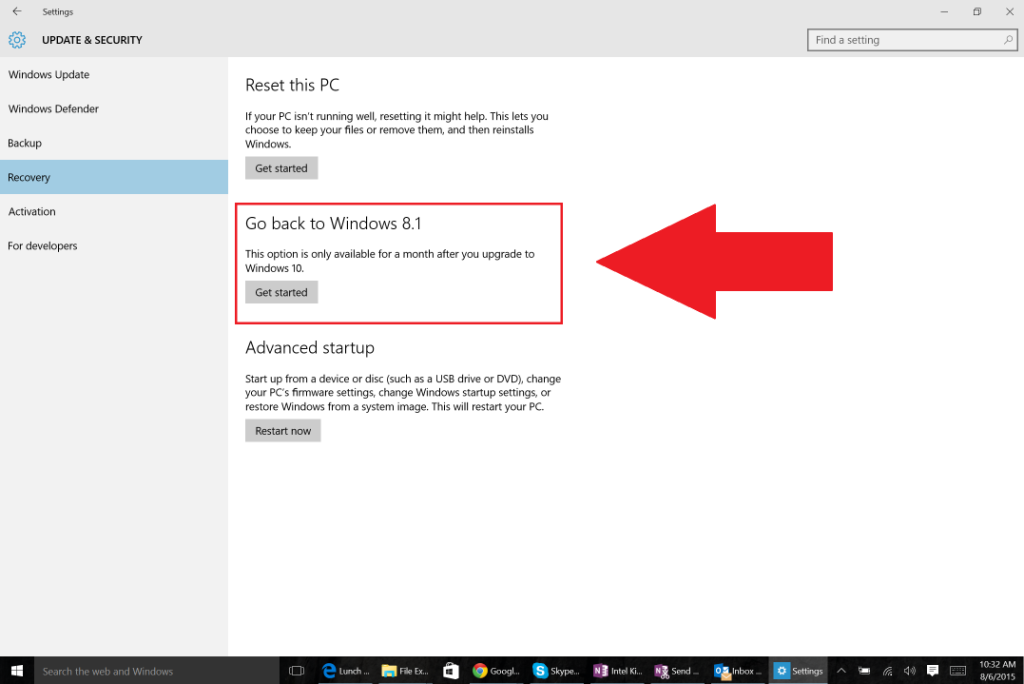
You’re allowed to roll back to your previous Windows version for 30 days after upgrading to Windows 10. Simply open the Start menu and head to Settings > Update & Security > Recovery. If you’re eligible to downgrade, you’ll see an option that says “Go back to Windows 7” or “Go back to Windows 8.1,” depending on which operating system you upgraded from. Simply click the Get started button and go along for the ride.

Once you’ve returned to your previous version of Windows, you need to tinker with it to perfect your setup once again. In particular, you may need to reinstall some programs, and don’t forget to use your Windows 7 password rather than your Windows 10 password if you created a Microsoft Account for the new operating system during the set-up process.

Stop it from happening again

Once you’ve upgraded a PC to Windows 10, you’ll always be able to do so again in the future. But if you aren’t enticed by Windows 10’s best features and more subtle awesome tweaks—a feeling I completely understand after a non-consensual upgrade—you can turn to a pair of helpful tools to disable the Windows 10 upgrade prompts from returning.

GWX Control Panel was the first anti-Windows 10 pop-up tool on the block, and it works marvelously, though its complicated user interface is full of granular options and may turn off some people. Never10 by noted security researcher performs the same basic task in a much simpler way. Either program does the trick.

GWX Control Panel and Never10 will also prevent your computer from being upgraded to Windows 10 if it hasn’t yet. Installing one of those is a much better option than disabling Windows Updates completely to avoid Microsoft’s pestering, as disabling patches can leave you vulnerable to new security flaws.

Now for the good news: Microsoft says it plans to phase out the GWX pop-up once it starts charging for the Windows 10 upgrade in July. Fingers crossed.

Have questions?

Get answers from Microsofts Cloud Solutions Partner!
Call us at: 856-745-9990 or visit: https://southjerseytechies.net/

South Jersey Techies, LL C is a full Managed Web and Technology Services Company providing IT Services, Website Design ServicesServer SupportNetwork ConsultingInternet PhonesCloud Solutions Provider and much more. Contact for More Information.

To read this article in its entirety click here.

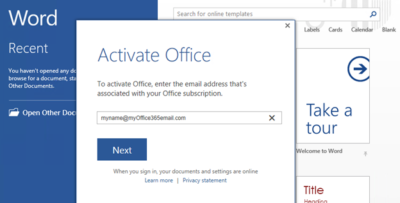
Office 365 Activation: How to Fix

Imagine you are a customer of Microsoft’s Office 365 service, including a subscription to the Office desktop applications like Word, Excel and Outlook.

One day you click on the shortcut for Word, but instead of opening, it just shows a “Starting” splash screen which never progresses.

Being smart, you try to start Word in safe mode by holding down the Ctrl key, but the exact same thing happens.

Annoying, when you want to do your work. What is going on?

We took a look at a case like this. Two things you should do (after the usual reboot):

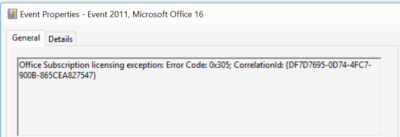
1. Look in the event viewer. Here, we found a clue that the issue is related to software activation, specifically Event 2011 “Office Subscription Licensing exception”:

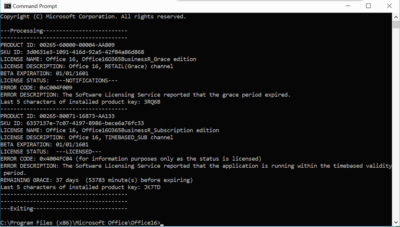
2. For all things related to Office licensing, open a command prompt, go to (for example) C:\Program Files (x86)\Microsoft Office\Office16, and type:

cscript ospp.vbs /dstatus

In this case we got the following:

This told us that Windows thinks TWO product keys for Office are installed. One has expired, the other is fine.

The guilty party may (or may not) be the trial version of Office typically pre-installed with a new PC. Or it could be a consequence of changing your Office 365 subscription. Neither would be the fault of the user, who is fully licensed and has done nothing other than follow Microsoft’s normal procedures for installing Office 365.

Solution: we reinstalled Office from the Office 365 portal, and attempted to remove the dud product key with:

cscript ospp.vbs /unpkey:<Last five characters of product key>

as explained here. All is well for the moment.

Activation and subscription license checking is for the benefit of the vendor, not the user, and should never get in the way like this.

Further, cannot Microsoft find some way of informing the user when this happens, and not have Word simply hang on starting? How difficult is it to check for licensing and activation issues, and throw up a message?

CALL US NOW!