The latest numbers from the company show businesses are close to schedule to move away from Windows 7 before the older OS retires in early 2020.
Windows10 Enterprise
Microsoft on Tuesday said that some 200 million enterprise workers now run Windows 10, a sign that corporations and other businesses are close to schedule to scrub Windows 7 from their machines before that older OS retires in about 20 months, an analyst argued.
“The 200 million resonates with me, based on what I’m hearing from clients,” said Stephen Kleynhans of Gartner Research. Migrations to Windows 10, he added, are progressing “pretty aggressively.”
Joe Belfiore, a corporate vice president who leads the Windows 10 team, revealed the number at Microsoft’s Build developers conference Tuesday. “Right now, there are over 200 million people in corporate accounts using Windows 10,” Belfiore said as he claimed deployment is “really ramping up” in the enterprise. “We’ve seen that [Windows 10] adoption rate increase now at 79% year-over-year growth.”
The day before, Microsoft contended that “nearly 700 million” devices are running Windows 10 worldwide. On that basis, enterprises accounted for less than 30% of all copies of Windows 10.
(Although the two numbers – Belfiore’s 200 million people using Windows 10 in corporate settings and Microsoft’s 700 million devices powered by the operating system – measured two different things, it’s not uncommon for Microsoft to obfuscate this way to prevent direct comparisons. In actuality, because Microsoft typically sells licenses on a per user basis, with multiple devices allowed for each user, 200 million people may be using more than that number of Windows 10 devices.)
While neither the percentage nor the 200 million are to be sneezed at, the former is significantly less than the average overall for commercial PCs, which have historically accounted for more than half – 55% has been an often-cited figure – of all personal computers.
And while Kleynhans did not dispute Microsoft’s claim of 200 people running Windows 10 in the enterprise, he sounded a bit disappointed in the number. “Is it a low number? It’s a little behind where I thought it would be,” Kleynhans said, noting that he expected it to be around 250 million by this point, perhaps even close to 300 million.
That 2009 operating system will fall off Microsoft’s support list on Jan. 14, 2020, meaning that while Windows 7 will continue to work as before, the Redmond, Wash. will stop distributing security updates to it.
It’s unrealistic to expect that all commercial customers will have purged Windows 7 by the retirement date, Kleynhans said, pointing out that he has recently spoken with clients who still run some instances of Windows XP (retired from support in 2014) and even Windows 98 (2006).
“What we [Gartner] expect is that enterprises will get to the 85%-90% level by the deadline,” Kleynhans said of the percentage of corporate devices shifted to Windows 7, “maybe even a little higher than that.” Nothing that’s happened has changed that estimate, he added.
“There are always laggards,” Kleynhans said.
According to other metrics, there may be a considerable number of them.
Estimates from analytics vendors, including U.S.-based Net Applications, which measure user and usage shares, signal that a large resorvoir of Windows 7 users will remain after the operating system’s retirement in 20 months. Net Applications’ latest data, for example, drove a Computerworld forecast that of the world’s Windows personal computers – all the PCs, not just those in the enterprise – 42% would still be running Windows 7 in January 2020, a much larger percentage than the 29% powered by Windows XP when that edition fell off the support list in April 2014.
In the end, large organizations will do what it takes to get off Windows 7 and onto Windows 10 by the former’s support cut-off date. The 200 million touted by Belfiore this week will be quite different a year from now, Kleynhans was certain.
“The speed with which I see Windows 10 moving now, it’s not going to be an issue,” he said.
Windows 10 deployment is, like previous iterations of the OS, on a timetable not of its own making. Instead, because of the vagarities of Microsoft’s historical release schedule and corporate acceptance (or rejection) of some editions, there is a clock ticking on Windows 10 because of the impending retirement of the current corporate standard, Windows 7.
Depending on how your Windows servers are configured, you may need to disable SSL v3.
Note that older versions of Internet Explorer may not have the TLS protocol enabled by default. If you disable SSL versions 2.0 and 3.0, the older versions of Internet Explorer will need to enable the TLS protocol before they can connect to your site.
For a Simpler Way to Disable the SSL v3 Protocol:
DigiCert is not responsible for any complications or problems if you decide to use this .zip file to disable the SSL v3 protocol on your server.
Log into your server as a user with Administrator privileges.
Download DisableSSL3.zip, extract the .zip file contents, and then double-click DisableSSL3.reg.
In the Registry Editor caution window, click Yes.
Restart server.
If you prefer to do it yourself, follow the steps in the instruction below.
Microsoft IIS: How to Disable the SSL v3 Protocol
Open the Registry Editor and run it as administrator.For example, in Windows 2012:
On the Start screen type regedit.exe.
Right-click on regedit.exe and click Run as administrator.
In the Registry Editor window, go to:HKEY_LOCAL_MACHINE\SYSTEM\CurrentControlSet\Control\SecurityProviders\Schannel\Protocols\
In the navigation tree, right-click on Protocols, and in the pop-up menu, click New > Key.
Name the key, SSL 3.0.
In the navigation tree, right-click on the new SSL 3.0 key that you just created, and in the pop-up menu, click New > Key.
Name the key, Client.
In the navigation tree, right-click on the new SSL 3.0 key again, and in the pop-up menu, click New > Key.
Name the key, Server.
In the navigation tree, under SSL 3.0, right-click on Client, and in the pop-up menu, click New > DWORD (32-bit) Value.
Name the value DisabledByDefault.
In the navigation tree, under SSL 3.0, select Client and then, in the right pane, double-click the DisabledByDefault DWORD value.
In the Edit DWORD (32-bit) Value window, in the Value Data box change the value to 1 and then, click OK.
In the navigation tree, under SSL 3.0, right-click on Server, and in the pop-up menu, click New > DWORD (32-bit) Value.
Name the value Enabled.
In the navigation tree, under SSL 3.0, select Server and then, in the right pane, double-click the Enabled DWORD value.
In the Edit DWORD (32-bit) Value window, in the Value Data box leave the value at 0 and then, click OK.
Restart your Windows server.You have successfully disabled the SSL v3 protocol.
For instructions about disabling browser support for the SSL v3 protocol, see Disabling Browser Support for the SSL 3.0.
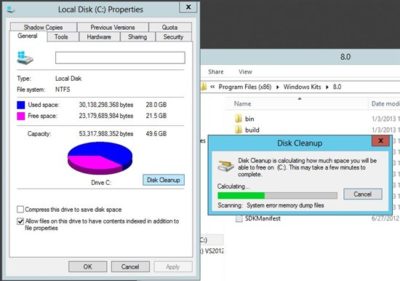
After performing an in-place upgrade on a Windows machine, you will find a WINDOWS.OLD folder in the root of C:. This folder will have a backup of your old program files, appdata and Windows folder… just in case you need to revert back or recover something that might have been lost during the upgrade. When you try to delete it though you are told you don’t have permissions. Just a small point here, it is generally not recommended to do in-place upgrades on servers. In fact there are some products (e.g. Exchange, ConfigMgr) that explicitly state they do not support upgrading the Operating System. There is of course a difference between “what works” and “what is supported”, but we do suggest where possible you do a clean Server install and migrate your application to the new server. Anyway, let’s assume you’ve understand all the risks and have done a successful in-place upgrade, you now find the old WINDOWS.OLD folder of several GB in size sitting there. If all is well, then you might as well just delete it.
SOLUTION
On Desktop OS version, you can just use the disk cleanup tool to remove it, but that is not available (by default) on Servers, so there are a couple of approaches.
Command line tools to take ownership and delete the folder. Make sure to “run as administrator”
How can I delete the windows.old from an upgraded Windows Server?
For a client OS that’s upgraded, the Disk Cleanup utility can be used to delete the very large windows.old folder containing the old OS. This isn’t available on a server OS without installing the Desktop Experience feature.
To delete, it is necessary to take ownership of the folder, give administrators full control, then delete. This can be done with the commands below:
What’s your company’s policy on employees using social media in the workplace?
Many companies today are still fearful of employees using social media, especially while at work. Employer concerns range from loss of productivity, industry espionage, confidentiality breaches, and public complaints about the company and/or its managers. As a result, some companies have requested access to employee (or potential employee) Facebook profiles, as well as blocked access to social networking sites while at the office.
In contrast, other companies — for example RingCentral — encourage employee engagement on social media. There are multiple benefits to embracing employees using social media in the workplace, as illustrated by the below infographic from SilkRoad, a cloud-based social talent management solution. At RingCentral, we prefer that employees get involved with our social media channels, and we encourage them to share news about the company through their personal social networks. To prevent any confusion, we implemented a social media corporate policy that clarifies the dos and don’ts of participating in social networks as a RingCentral employee. The net net? The benefits of employees on social networks far outweigh the negatives.
Is your company supportive of employees using social media?
Takeaway: Risks with staying with Windows XP after April 8, 2014.
Since being release worldwide on October 25, 2001, Windows XP has become one of the most popular versions of Windows. OEM and retail sales of Windows XP ended in June 2008, while smaller OEMs continued to sell the Operating System until January of 2009.
On April 10, 2012, Microsoft officially announced that as of April 8, 2014 they will end extended support for Windows XP and Office 2003, after which no new bug fixes or patches will be issued.
Organizations may be taking a spontaneous risk and assume that Window’s XP’s prolonged life means major vulnerabilities have been acknowledged and dealt with. If XP were secure, there still might be application-level vulnerabilities. Even the ranges of security breaches are inadequate to persuade some organizations that are still using Windows XP to upgrade. The dynamics that have safeguarded XP’s success are now working against the organizations that stuck by the operating system.
A major aspect attackers assess during their investigation is the operating system and the applications used within an organization. With Microsoft ending their support, the vendors for applications running on it will most likely end support.
On the other hand, those preparing to continue using XP after the cut-off date, are going to be in a unpleasant situation trying to protect their intellectual property, but can take certain steps to limit exposure to risk. There are specific technologies you could deploy that will permit you to remain using legacy systems. Mitigating technologies like Host-Based Intrusion Protection will be able to identify that a vulnerability exists and make that vulnerability difficult/impossible to exploit by applying a virtual patch to those non-supported environments.
However, XP’s acceptance is down to the technology itself and an operating system format that people are content with. The significant changes with Windows Vista, Windows 7 and especially Windows 8 are the reason people are resistant to change.
You may take email for granted. However, effective email communication is as much a skill as anything else. When used effectively, email can be a powerful tool. However, one of the top email inefficiencies is message length. One of the top reasons your email isn’t getting read is because it is too long. Writing long emails doesn’t mean you are getting more work done. As people are fighting to get their inbox to empty, the last thing they want to do is read a multi-page rambling email.
Keep Those Emails Short
Resist the urge to write long and drawn out messages. If you find yourself writing long responses, you probably should be having a conversation, not an email writing contest. The shorter and tighter your email messages, the better chance that they will be read, understood and acted upon.
Here are 10 Reasons That Your Emails Are Too Long
You don’t know what you are trying to say. It’s like when someone calls you and says, “What’s up?” Um, I don’t know… you called me. Hold that email until you have something specific to say or ask.
You don’t know what you are talking about. This is similar to when people endlessly talk in meetings to cover up their lack of information. Writing more isn’t going to cover up the fact that you are lacking knowledge. This practice occurs in many companies when individuals send emails to “appear” busy.
Your signature is unnecessary. Your half-page signature doesn’t need to be on all of your emails. Do you send emails with a 1 word response and then half of a page of signature? As well, please lose the attached graphic and cute quote.
You are writing a book. Emails are not books. If there is additional information, attach supporting documents. If you are putting a large table in your email, you should stop and consider whether it should be in an attachment.
You are spamming. This happens often in larger corporations. Employees feel the need to send each other lengthy updates of what they have been doing. And it’s not just the remote employees.
You are rambling. Don’t write a 2-page email to ask a 1-line question. Be direct. Thanks.
You are forwarding a mess. Instead of taking the time explain, you just forward your email stream. Ever get one of those, “See below..!” messages. Um, I don’t want to read the 45 page back-and-forth that you participated in.
It shouldn’t be an email. Don’t send an email when it should be a meeting or a phone call. Sometimes email isn’t the right medium for your message. If it is taking more than a few lines to explain, then go talk to the person you need to communicate with.
It should be multiple emails. Here is a good one. One boss combines all of the team items into one email. You may think this is an attempt at efficiency, however combining multiple emails into one doesn’t work for everyone involved. And it creates great aftermath when people “Reply All.”
You don’t edit your emails. After you write an email, you should edit it before sending. Besides the obvious spelling and grammatical errors, you should be editing for content, meaning, and conciseness. Another good thumb-rule: the number of times you should re-read an email before sending is equal to the number of people you are sending it to. (And yes, this rule scales.)
Make Sure Your Email Gets to the Point
In today’s high-speed communication, no one wants to read overly long email messages. If your emails are brief and to the point, your recipients will be more likely to get the point. Remember that short and sweet will beat the 3-page email every time.
Takeaway: From diagnostic tools to antivirus to backup utilities, this list of freebies will help you do more with less.
If you’re trying to stretch a thin IT budget, you probably can’t afford a lot of pricey tools. Luckily, a number of highly useful tools are available for free. Some of them even work better and are more efficient than their costlier alternatives.
1: ComboFix
When the standard antivirus/malware software can’t seem to find the problem, ComboFix almost always does. It also looks for and removes most rootkits and Trojans. To use this tool, you must completely disable all antivirus solutions (and you should completely remove AVG). Caution: If ComboFix is not used properly, it can wreak havoc on the machine you’re trying to fix.
2: ProduKey
ProduKey will help you get product keys from installed applications so that when you need to migrate to a new machine, you can continue using those costly licenses. ProduKey will recover keys from more than 1,000 software titles, including Microsoft Office, Adobe, and Symantec. When you use this tool, you will have both the product ID and the product key; the ID is important because it will tell you which version of the software is installed.
3: Hiren’s BootCD
Hiren’s BootCD is a one-stop-shop Linux boot disk that can help you pull off a number of small miracles. Its tools include Antivir, ClamWin, ComboFix, Clonedisk, Image for Windows, BIOS Cracker, 7-Zip, Bulk Rename, Mini Windows XP, CCleaner, and Notepad++, among others. This single bootable disk could easily be the only tool you need.
4: Microsoft Security Essentials
Microsoft Security Essentials is one of the better free antivirus tools available. Its tagline, “The anti-annoying, anti-expensive, anti-virus program,” is true. When the firm I work with was looking for a new free solution, we tested Microsoft Security Essentials against AVG Free and Avast Free and found Microsoft Security Essentials to be superior, less intrusive, and less resource intensive.
Note: Microsoft Security Essentials can be used for free for up to 10 PCs. Beyond that, you can purchase the business version, System Center Endpoint Protection.
5: WinDirStat
WinDirStat is the program you need when you must know what is taking up the space on a hard drive. When C drives begin to fill up, performance degrades rapidly. It’s essential to have a tool to help you discern what is gobbling up the precious space on a machine, and WinDirStat is the foremost app for getting this information quickly.
6: CCleaner
CCleaner gets rid of temporary files and Windows Registry problems faster than any other tool. When a machine is having problems, this is almost always the tool I use first. CCleaner also helps ensure privacy by getting rid of traces left behind (such as cookies) by Web browsers.
Note: It is legal to use CCleaner Free for business use. However, CCleaner Business Editioncomes with a few more features (including one-click cleaning) than the free version.
7: Defraggler
Defraggler blows away the defragmenting application in all Windows operating systems. It’s faster, more reliable, and more flexible than the built-in tools. With Defraggler, you can defrag a single file or an entire drive. Defraggler supports NTFS and FAT32 systems.
8: 7-Zip
7-Zip is the best file archiver/compression tool (outside of Linux command-line tools). It’s open source and works on multiple platforms. Once you install it, you will find 7-Zip has Explorer support and a simple GUI tool that any level of user can manage.
9: SyncBack
SyncBack is a reliable, easy-to-use backup utility. No, you won’t be recovering from bare metal, but you can save your precious data. SyncBack can synchronize data to the same drive, a different drive or medium (CDRW, CompactFlash, etc.), an FTP server, a network, or a zip archive.
10: FileZilla
FileZilla reminds you that the cloud has not made FTP useless. There are plenty of reasons you might need FTP, so why not use one of the best and most cost effective FTP clients? And if you need an easy-to-use FTP server to slap up on your Windows machines, FileZilla has one.
Can’t change the Windows 7 theme? Is your Windows 7 theme stuck on “classic”? If it is stuck, then you can try to apply a few fixes and see if if you can unstuck it! Often it is stuck, because your PC is configured to be optimized for best performance, rather than best appearance!
Overview
Configure PC for better Appearance Start Windows 7 Themes Service Problem: Themes Service Cannot Be Started
Use Visual Styles on Windows and Buttons
Often the reason why your Windows 7 theme could be stuck on classic is that your PC is configured to be optimized for better performance. I could imagine that some laptops are even pre-configured that way. Actually, it’s a good setting, but if you want a better appearance I can understand that it’s annoying to be stuck on “classic” theme. So, if you can’t change your Windows 7 theme, you might want to check your PC configuration first:
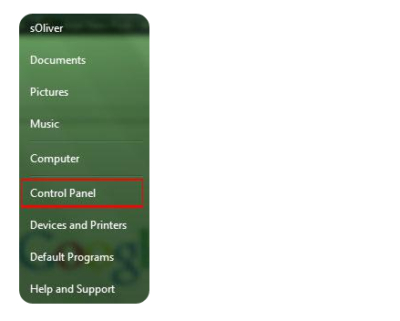
1. StepOpen the Control Panel
2. Click on “System and Security”:
3. Step Click on “System”.
4. Step In the sidebar, click on “Advanced System Settings”:
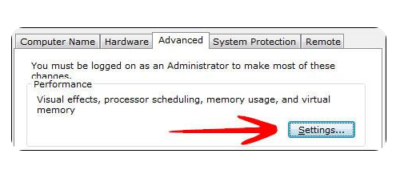
5. Go to the tab “Advanced” and click on “Settings”:
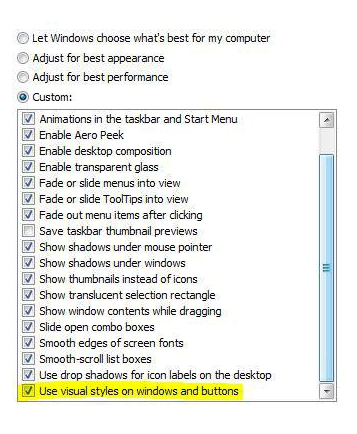
6. Step Scroll down the list, at the bottom double-check that the item “Use Visual Styles on Windows and Buttons” is checked. If this is not checked, your Windows 7 theme will be stuck on “classic” for a long time, because this completely disables your fancy visual Aero appearance.
This is also often the problem why people can’t seem to be able to active the Windows 7 Aero theme, because their PC is configured to be optimized for the best performance and not the best appearance.
Themes service is not started
If your Windows 7 themes service is not started your Windows 7 theme will be stuck on “classic”. You can’t change your Windows 7 theme when the theme service is disabled. So, let’s check if your themes service is up and running.
1. Step Click on “Start” and enter “services.msc” into the search field. Click on the item that appears.
2. Step Scroll down the list until you find the item “Themes” (or enter Themes while one item is selected)
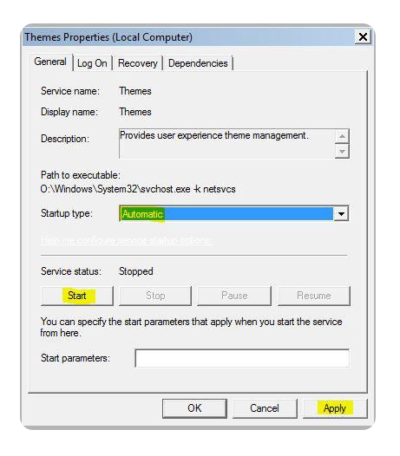
3. StepYou will now see if the Themes service is running currently and what mode it is in (Automatic, Disabled, Manual):
If it’s currently “Disabled” or in “Manual” mode and not started, you have to start it manually and change the mode to “Automatic”.
4. StepDouble-click on “Themes” and from the dropdown select “Automatic”, click on “Start” and then on “Apply”.
5 things to do before giving an old iPhone or iPad to your kid
Don’t hand over an aging iOS device to your eager youngster before doing a little kid-proofing first.
Like it or not, little kids love iPhones and iPads. They love to look at them, they love to tap and swipe the screen, they love playing iPhone games, and most of all, they love watching videos on them. (“Curious George” is my daughter’s favorite—for this week at least.) Giving your little ones a hand-me-down iOS device is an easy way to satisfy their desire for a screen of their own—my kid is the proud owner of an iPhone 3GS and a third-generation iPad. That said, you shouldn’t hand over your old iPhone or iPad without doing some kid-proofing first. Read on for five ways to prep an aging iPhone or iPad for your youngster, from wiping your data and setting up a child’s iCloud account to blocking web access and keeping her from racking up in-app charges on your credit card.
Wipe your old data
Before you hand over your old iPhone to your kids, you’ll want to make sure any and all of your personal data has been wiped clean. The best way to do so is to perform a “factory” reset, which wipes the iPhone’s storage and returns it to its factory settings.
Make sure to back up and then wipe your data before handing over your old iPhone to your child.
Naturally, you should first make sure you’ve backed up any old iPhone or iPad data you want to preserve. You may already have taken care of this step if you’ve previously upgraded to a new iPhone or iPad and restored your data from iCloud. If not, tap Settings, tap your iCloud profile, then tap iCloud > Backup > Back Up Now. You can also back up your old iPhone or iPad by connecting it to your Mac or PC and syncing it with iTunes.
Once you’re satisfied that your data is safe and sound, go ahead and wipe the device. Tap Settings > General > Reset > Erase All Content and Settings. Once the reset is complete, your old iPhone or iPad will return to its factory settings, just like the day it came out of the box.
Create a child’s iCloud account
While it may seem a little soon to, say, create an Apple ID for a toddler, take it from me: it won’t be long before your onesie-clad cutie is walking, talking and pleading for an iPhone upgrade—and when that happens, it’ll be easier to migrate her data and apps if she already has her own iCloud account.
Just because your child is under 13 doesn’t mean she can’t have her own iCloud account and Apple ID.
Even if your kid is younger than 13 years old, she can still have her own iCloud account and Apple ID. All you need to do is create the account under iOS’s “Family Sharing” umbrella. With her iCloud account, your child will be able to sign in to an old iPhone or iPad, download apps, and even purchase items from the App Store—only with your approval, of course.
Also, keep in mind that just because she has an iCloud account, your daughter or son won’t be able to start web surfing, tweeting, or posting selfies on Instagram without your say-so. (More on iOS’s parental controls in a moment.)
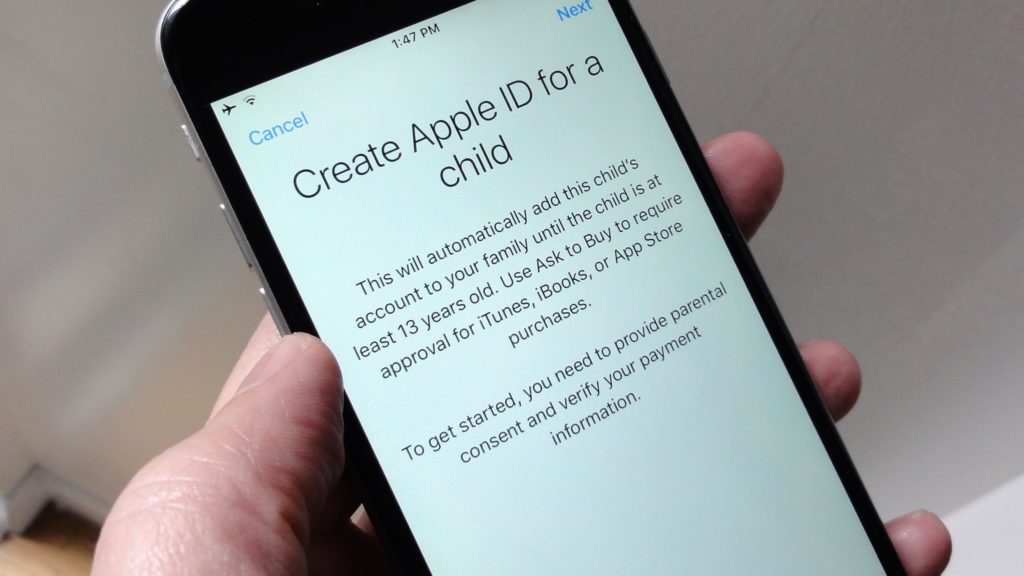
You can create a child’s iCloud account directly on your own iPhone or iPad. Just tap Settings, tap your iCloud username, then tap Family Sharing > Add Family Member > Create an Apple ID for a child.
You’ll need to enter your kid’s birthday, agree to some disclosures and legalese, choose a payment method for App Store purchases (which, again, you can control and/or block), then choose an Apple ID username and password.
By default, your kid’s new iCloud account won’t let her make App Store purchases without your consent. To double-check the “Ask to Buy” setting, tap Settings, tap your iCloud account name, then tap Family Sharing and your kid’s name.
Control what your kid can—and can’t—do on her iPhone or iPad
Once you’ve got your old iPhone or iPad set up with your child’s new iCloud account, it’s time to make some decisions on which iOS features will be fair game for your kid, and which will be off-limits.
Don’t want your child surfing the web or snapping photos on her hand-me-down iPhone? You can block those activities in iOS’s Restrictions settings.
Tap Settings > General > Restrictions > Enable Restrictions, then create a Restrictions passcode.
Next, scroll down and disable all the iOS features that you’d rather your kid not mess with. You’ll probably want to disable Safari and the iTunes store right away. You may also want to block your child from installing apps, and if you don’t want your little one snapping a million photos of their crib, you might want to nix the Camera app, too.
In the “Allowed Content” section, make sure to disable in-app purchases, as well as block music with explicit music and any grown-up movies, TV shows and books.
In the Privacy section, you can control which apps can access location services, contacts, the microphone, and more on your kid’s iPhone.
At the bottom of the Restrictions screen, you can also disable access to multiplayer games, friend adding, and screen recording for any Game Center-ready games.
Hide Settings, Mail, and other Apple apps
Even after you’ve thoroughly managed all of iOS’s Restrictions settings, you may still see some home-screen icons on your kid’s iPhone or iPad that you’d rather she not mess with. For example, the Settings icon should probably stay out of her hands, as well as the Mail app, Game Center, and the App Store.
You can hide the Mail, App Store, and other Apple apps in a folder, preferably on its own home screen in the back.
Here’s what I did before I gave my daughter my old iPhone: I hid all those various Apple apps in a “Hidden” folder in the very last iOS home screen. To create a home screen folder, drag one app icon on top of another, name the folder, then start dragging other app icons into the newly created folder.
Naturally, older kids who are a bit more iOS savvy may quickly sniff out the “Hidden” folder. My five-year-old, for example, knows exactly where I’ve tucked away the Settings icon, but she doesn’t really care—probably because tapping Settings won’t get her any closer to Curious George.
Turn on Airplane mode
One way to make sure your little one doesn’t wander into a grown-up corner of the Internet on her iPhone is to cut off Internet access altogether, and the easiest way to do that is to turn on Airplane mode. (Of course, you can kiss Airplane mode goodbye once your children start clamoring for the streaming PBS Kids video app, which they’ll do once they hit about 3 or so.)
Just tap Settings, then flip on the Airplane Mode switch.
Turning on Airplane mode is an easy way to keep tiny iPhone users off the Internet.
If your old iPhone or iPad is running on iOS 6 or later, you may also want to disable home-screen and in-app access to Control Center, the flip-up control panel that includes an Airplane Mode button, To do so, tap Settings > Control Center, then switch off the Access on Lock Screen and Access Within Apps settings. That won’t completely disable Control Center, but at least it’ll make it a tad more challenging to find.
Hulu’s channel bundle attacks the norms of pay TV service—for better and for worse.
Hulu with Live TV is not the channel bundle you might’ve grown up with. The $40-per-month streaming service clearly wants to be something other than cable.
Aside from being cheaper than the average pay TV package, Hulu’s new bundle aims to blur the lines between live TV, on-demand shows, and DVR. It pushes personalized recommendations on what to watch, and it shunts the notion of channel-flipping out of the spotlight. Recordings, on-demand episodes, and Hulu’s existing TV and movie library intermingle in ways that obscure the source of what you’re watching, as if to suggest that only the content matters.
Hulu’s attempt to distance itself from the legacy TV experience is refreshing, and it can lead to discovering some great television. But it can also be disorienting, due to an expansive, sometimes confusing menu system. Hulu also accurately describes the current service as a beta, and it’s marred by limited device support and occasional glitches. We’re not going to render a review score until Hulu lifts the beta tag; in the meantime, cord-cutters signing up for the service in its current state should be aware they’re paying for an unfinished product.
Hulu’s bundle is one-size-fits-all, with more than 60 channels for $40 per month. That puts it in the ballpark of other streaming bundles’ primary offerings, though Hulu throws in access to its existing on-demand service—an $8 per month value—to sweeten the deal. The ad-free version of that existing service costs an extra $4 per month, and you can still tack on Showtime’s on-demand catalog for another $9 per month.
Channel highlights include ESPN, Disney channels, regional sports from Fox and Comcast, all three cable news networks, and on-demand video from all four major broadcast networks. In certain markets, you can get live feeds from local broadcast stations as well. (A full channel list appears at the bottom of this review, and Hulu’s sign-up page lets you enter a zip code for a list of local stations.)
Hulu includes roughly 60 channels for $40 per month—no more, no less.
Like other streaming bundles, Hulu omits some networks to keep prices down. AMC Network channels, Discovery channels, and Viacom channels such as Comedy Central and MTV are all absent from Hulu with Live TV, as are league-based sports channels such as NBA TV, MLB Network, NFL Network, and NFL Redzone.
The service does include 50 hours of DVR at no extra charge, but with some opaque rules and restrictions. Some live channels let you rewind to the start of a program even if you haven’t set up a recording, and then allow you to skip commercials. Others allow automatic rewinding, but not ad-skipping. Recordings are supported on all channels, but some won’t let you skip ads unless you pay an extra $15 per month for expanded DVR, which also increases storage to 200 hours.
Hulu’s cloud DVR lets you record individual episodes or entire series.
Subscribers can add up to six user profiles and are allowed up to two streams at a time, either inside or outside the home. That’s the same as DirecTV Now, and better than Sling TV Orange, but less than PlayStation Vue, Sling TV Blue, and YouTube TV. It also leads into another upsell: For $15 more (or $20 total combined with expanded DVR service), you can stream on unlimited devices at home and three devices on the road.
Currently, Hulu with Live TV runs on Apple TV, Xbox One, Chromecast, iOS, and Android. Live TV subscribers can still use Hulu’s on-demand service on a longer list of devices. The service also includes access to a handful of cable-authenticated apps, but the limited device support for live channels is one reason Hulu has applied a beta tag for now.
How Hulu Works
As for the experience of using Hulu with Live TV, it’s at once gorgeous, empowering, and utterly overwhelming.
Top-level navigation splits into three main sections: The “Home” section focuses on recommendations and quick access to recently-watched programming. The “My Stuff” section pulls in all the channels, shows, and movies that you’ve marked as favorites, including both on-demand and DVR content. The “Browse” section is a catch-all for everything else, including genres and a full channel list.
Logical as this layout may seem, the purpose of each section isn’t immediately self-evident. Each section also has numerous subsections, which in some cases share a name with subsections in other parts of the interface. For instance, there are four menus entitled “Sports,” three menus entitled “Movies,” another three entitled “TV” or “TV Shows,” and two ways to access your favorite channels. These redundantly named sections rarely behave in exactly the same way. Better labelling could be a short-term fix, but Hulu would really benefit from consolidating the interface into fewer branching pathways.
In the “My Stuff” section, the “TV Shows” menu provides a list of your favorite shows. But there’s a different menu by the same name under the “Browse” section.
At least the Hulu interface isn’t lacking ways to discover things to watch. During setup, Hulu asks users to pick some favorite channels and genres, which fuel the recommendations on the home screen. Intriguing subsections such as “Star Wars” and “Binge-worthy” pepper the home screen, and browsing the genre menus yields fun results such as “Workplace Shenanigans” and “Nostalgia TV.” You can also search for shows, channels, and genres, but not for actors or directors.
Other parts of the interface show promise, but need further development. Hulu’s centralized menu for favorite sports teams is brilliant, but did not come with any setup process on Apple TV. (A menu for setting up favorite teams did appear on the Xbox One app). Support for kid-friendly user profiles is also helpful in theory, though it lacks parental lock and misses the mark with age-based recommendations. No disrespect to the unashamedly bizarre Uncle Grandpa, but it’s not appropriate for a three-year-old.
Hulu lets you track all your favorite sports teams from one place.
Performance Hits and Misses
By calling itself a paid beta, Hulu with Live TV is trying to inoculate itself against early criticism for glitches and performance hiccups. And there have been a few.
For instance, I experienced a persistent issue on Apple TV where Hulu boots me out of a stream and back to its menu. Sometimes this would happen while attempting to fast forward, and a few times it’s occurred on its own. While I was always able to resume the channel or program in question, it happens frequently enough to be a nuisance.
The live channel guide—yes, this does exist; it’s accessible by taping or swiping up from any video—also has a design flaw that’s hopefully unintentional: The buttons to initiate a recording or view more information only apply to what’s playing in the background, not to whatever’s highlighted in the guide. This makes a chore out of recording or favoriting soon-to-air programs.
Yet in terms of reliability, Hulu with Live TV has performed well in my experience. Channel load times were initially a bit sluggish, but have improved over the past week, and I haven’t seen any show-stopping errors like the kind that afflicted DirecTV Now in its early days. Video resolution has been routinely crisp at 720p for live channels, 1080p for movies, and 4K for some originals.
Hulu managed to avoid any major buffering or freezing issues during our testing.
The only major problem concerns frame rate, which tops out at 30 frames per second for all channels and programs. That means you don’t get the smoothness of motion that’s typically found in live sports, news, talk shows, soap operas, and late-night programming. PlayStation Vue and DirecTV Now remain the best options for 60-frames-per-second viewing.
How does Hulu compare with other streaming bundles overall? To be honest, a strong opinion eludes me. The channel lineup is a fine cross-section of what cable TV has to offer, but with holes that may be disqualifying for some potential cord cutters. The interface deserves praise for its vision, but not so much for its execution. And the barrage of upsells—more DVR storage, no streaming limits, fewer ads—is grating even if the options are nice to have.
In the end, the right call on picking a streaming bundle is still to thoroughly examine all the options—their lineups, their features, their device support—and hope you find a match for your needs. In beta or otherwise, Hulu with Live TV just tilts the odds a little further in your favor.
Here’s the full channel list for the Hulu Live TV bundle: